
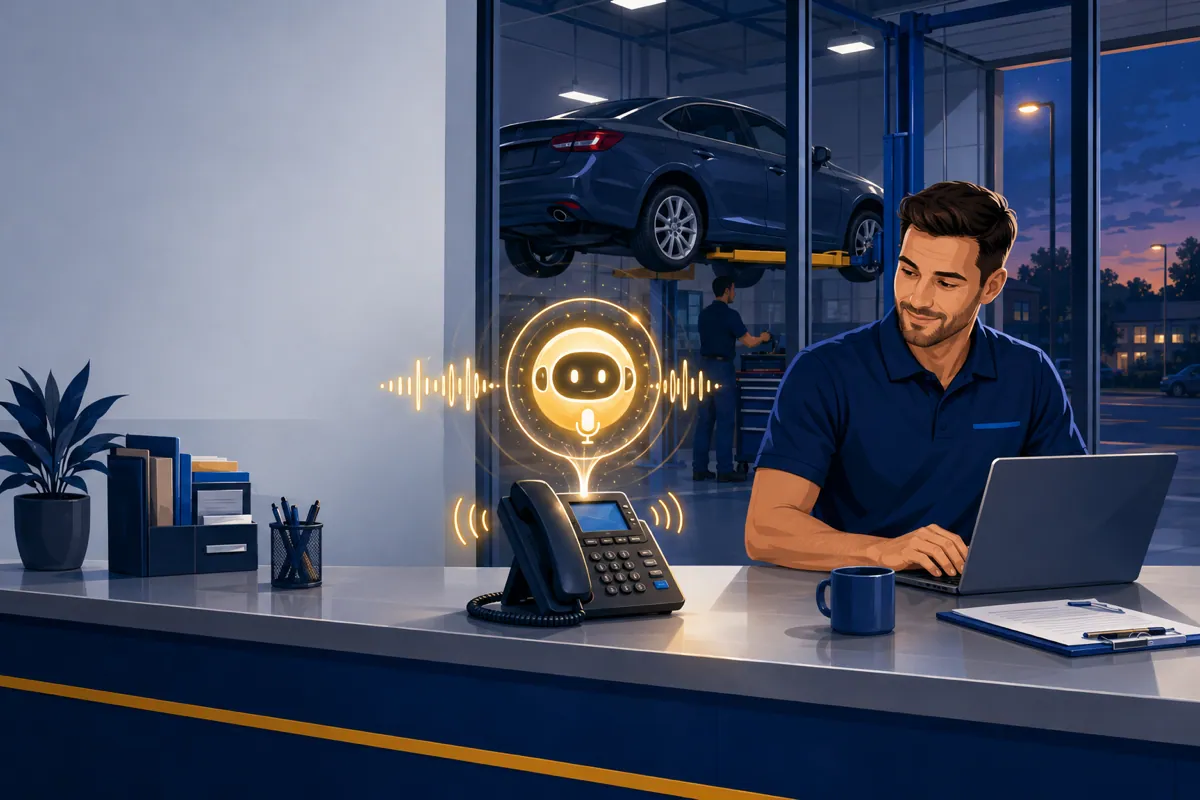

Your shop phone rings. Nobody’s free. Everybody assumes someone else grabbed it. (Growing up in my dad’s shop, we had a name for this: the phone version of a standoff where everybody loses, including the phone.) So it rings out, and a booked repair order just drove past your bay to the shop down the street.
That’s the question behind all the hype: should AI phone answering pick up when your team can’t? This is for the owner or multi-shop operator weighing an AI phone agent for the shop, not the customer trying to book an oil change. I’ll show you where it earns its keep, where it’ll embarrass you, and how to test one without torching customer trust. Read it in five minutes. Decide it before your next morning rush.
Your phone is the most expensive thing you ignore
Let’s put a number on the ringing.
Say a busy two- or three-bay shop drops 10 to 15 calls a week during the morning rush: advisors juggling walk-ins, estimates, and the guy who “just has a quick question” that takes eleven minutes. Not every missed call is new work. But say just two of those callers were ready to book.
At an average repair order of roughly $702 (accounting firm Paar Melis’s 2025 benchmark report, built from actual 2024 shop financials), two booked ROs a week is about $1,400 a week. Call it $73,000 a year rolling straight past your door.
Treat that as illustrative, not a promise. Your miss rate is your own, your close rate is your own, and I’d rather you measure yours than trust mine. But the shape of it holds at every shop I’ve seen. The phone is the cheapest lead source you own, and the one you drop the most.
Here’s the part that stings: you already paid to make that phone ring. The marketing, the sign, the Google listing, the reputation your techs built one repair at a time. The lead arrived. Nobody was home.
What an AI phone agent actually does
Strip the marketing away and an AI voice agent for auto repair does a handful of concrete things.
It picks up on the first ring, every time, at 2 p.m. or 2 a.m. It answers the routine questions: hours, location, “do you do brakes,” “can I get in Thursday.” It books an appointment. The good ones write that appointment straight into your shop management system so nobody re-keys it. It takes a message and texts your team a summary. And it hands off to a human when the call goes past its depth.
That’s it. That’s the job. It’s a receptionist that never takes lunch, never calls in sick, and never puts a customer on hold to go find a part.
What it is not is a service advisor. It doesn’t read a nervous customer, hold a price, or decide which deferred job to push this visit. Keep that line bright. We’ll come back to it, because it’s where most of the bad buying decisions happen.
Shops are curious, not sold
If it feels like everyone’s talking about AI and nobody’s actually running it, the data backs you up.
In the 2026 Ratchet+Wrench Industry Survey (a self-reported survey of more than 430 shop owners and managers), 21% said they’re very familiar with AI and another 42% somewhat familiar. That’s roughly 63% who know what it is. But 29% said they’ve heard of it and don’t use it.
Read that again. Two-thirds of shops know the technology. Nearly a third are standing at the edge of the pool, toe in the water, waiting to see who cannonballs first. (Nobody wants to be the shop whose AI told a customer the wrong hours on a busy Saturday. Fair.)
So the honest state of play: curiosity is high, commitment is low. That’s not a reason to wait. It’s a reason to run a small, controlled test while your competitors are still reading the brochure.
The three reasons shops haven’t pulled the trigger
The same survey asked shops why they haven’t adopted AI. The top three answers are the exact three objections you’re probably chewing on right now.
“I’m not sure what’s trustworthy”: 23%. The biggest blocker isn’t cost. It’s not knowing which vendor to believe. Fair, because most of them oversell. Cut through it with a demo on your own phone number and your own SMS, not a canned recording of a perfect call.
“It’s too expensive”: 20%. Price only means something next to what it captures. If an AI phone agent books two ROs a week you’d otherwise miss, the math from the top of this article covers a lot of subscription. If it books zero, no price is cheap enough. Measure before you judge.
“I don’t have time to implement it”: 19%. This one’s real. You’re running a shop, not a software rollout. Which is exactly why the pilot below is narrow: one call type, one location, one month. You don’t have to boil the ocean. You have to answer the phone after 6 p.m.
Here’s my one strong opinion on all this. An AI phone agent doesn’t fix a phone problem. It exposes a staffing one. If your calls ring out at 9 a.m. on a Tuesday, you don’t have a technology gap. You have more demand than your front counter can hold. The AI is a patch on a real, and frankly enviable, problem. Just be honest about which problem you’re solving so you don’t expect software to do a person’s job.
Where an AI agent earns its keep
Point it at the calls you’re already losing, and an AI answering service for auto repair shops pays for itself fast.
After-hours and weekends. The call that comes in at 8 p.m. on a Tuesday used to hit voicemail, and voicemail is where booked work goes to die. An AI agent books that customer for Thursday while your team’s home for dinner. This is the clearest win, because a booked call beats a dead one every time.
The morning and lunch overflow. When every advisor is writing an estimate and the phone’s ringing off the hook, the AI catches the overflow instead of letting it ring out. It’s not replacing your advisor. It’s covering the fifteen minutes your advisor physically can’t be in two places.
Tech-and-staff shortage relief. The industry’s number-one challenge is finding and keeping people, and it’s not close. The front counter feels it as hard as the bay. If you can’t hire a second service advisor to cover the phones (and right now, most shops can’t hire fast enough), an AI agent covers the routine calls so your one advisor spends their time selling, not reciting your hours.
None of this is theoretical. In the Ratchet+Wrench survey, 27% of shops already use AI for service-advisor scripts and 17% for scheduling and phone tools. And owners see 20% of AI’s potential in marketing and customer communications, the second-highest category behind technician support. The phone is squarely where shops are already pointing this thing.
Where it will embarrass you
Now the part the vendors skip on the demo.
An AI phone agent is bad (sometimes spectacularly bad) at judgment calls. The customer whose car came back with the same noise. The one disputing a bill. The one whose transmission job is three days late and who is, understandably, not in a joking mood. Those callers want a human who can own the problem and make a decision. An AI stuck in a polite loop on that call doesn’t save you money. It costs you a customer, and probably a review.
This is the augmentation-not-replacement line, and it’s non-negotiable. The right model is a copilot, not an autopilot. AI drafts, humans decide. The moment a call needs a judgment call, it belongs to a person. Any vendor promising to replace your advisors entirely is selling you a demo, not your Tuesday afternoon. (The AI cluster covers this same line across the shop: see how shops are actually using AI in 2026 and the 2026 automotive AI news view of hype versus reality.)
One more honest note while we’re here: an AI phone agent won’t help your back office at all. It books cars; it does not read a vendor invoice or catch a missed core credit. (WickedFile lives in that back-office world, not on your phone lines: different problem entirely, and I’d rather tell you that than pretend otherwise.) The phone and the parts ledger are two separate leaks. Fix the one you’re actually measuring.
How to pilot one without torching customer trust
You don’t roll this out across the group on day one. You run a test small enough that failure is cheap and success is obvious. Here’s the checklist.
- After-hours first. Point the AI only at calls that currently hit voicemail. A dropped call answered by AI is strictly better than a dead one. You literally cannot do worse than the voicemail it replaces.
- Warm human handoff, always. Give the caller a fast, obvious path to a person, and make sure the AI actually takes it when a call goes sideways. The handoff is the safety net. Test it before you trust it.
- Weekly transcript review. For the first month, read a sample of calls every week. Listen for the caller who got stuck, the question the AI botched, the booking that didn’t stick. This is where you find the call types to pull it off of.
- Judge it on booked ROs, not vibes. Track calls answered, appointments booked, and callers who bailed. The goal isn’t an AI that sounds human. It’s an AI that fills your schedule. A charming bot that books nothing is a very expensive answering machine.
- Then, and only then, scale it. If the numbers work at one location, roll it across the group. If they don’t, you spent one month and pocket change learning that. Cheap tuition.
So, should one answer your calls?
Here’s the framework, no hedging.
If you’re a single shop dropping calls after hours or during the rush: yes, pilot one, pointed at exactly those calls. That’s the cleanest win in this whole article, and the missed-call math from the top makes the case on its own.
If your team answers nearly every call live and books well: probably not yet. You don’t have a phone problem, and an AI agent won’t manufacture one to solve. Spend the money elsewhere.
If you’re a multi-shop operator: this is where it gets interesting. One location leaking a few calls a week is a rounding error. Ten locations each leaking a few calls a week is a real number, and it’s invisible until you measure it across the group. Standardize the pilot at one store, prove the booked-RO lift, then roll the same playbook to every rooftop. Consistency across locations is the whole MSO game. The phone is no different from any other operational challenge you’re managing at scale.
The technology is ready for the calls you’re already losing. It is not ready to be the voice of your shop for the calls that matter most. Know the difference, pilot the boring version first, and let the schedule tell you the truth. (For the full landscape of what else AI is doing in shops, our best AI tools for auto repair guide has the tool-by-tool rundown.)
Your phone’s about to ring again. This time, make sure somebody (or something) actually picks it up before your competition does.