
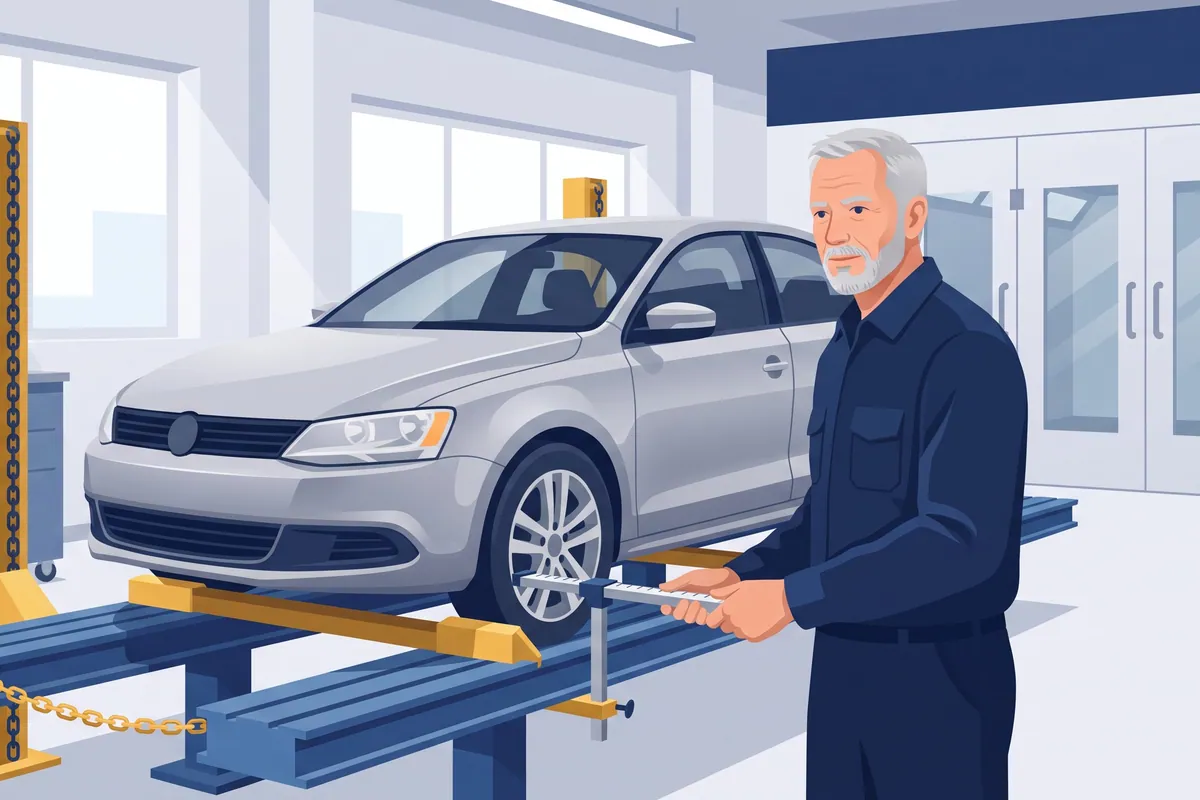

Auto body tools are everything a collision shop uses to fix a wrecked car: dent tools, a frame machine, welders, a paint booth, and scan and calibration equipment. Every body shop also has one tool nobody owns and everybody needs. It’s the good body hammer, and it lives in whichever bay borrowed it last. (The bad hammer is always exactly where you left it.)
This guide groups auto body shop equipment by the job it does, flags what’s regulated, and prints prices only where I could verify them on a seller’s page. Then it covers the part every equipment list skips: the paperwork that arrives with the tools.
(Full disclosure: I run WickedFile. It doesn’t sell, rate, or fix a single tool. It reads the invoices that come with them, and with the parts, paint and sublets on every job, and flags the ones that don’t match. Equipment first.)
The auto body shop equipment list, grouped by job
| Job | Core equipment | What drives the cost |
|---|---|---|
| Teardown and dent repair | Hammers and dollies, DA sanders, grinders, stud welder or dent puller, panel and trim tools, plastic repair kit | Quantity, since every tech needs a set |
| Structural repair | Frame machine or bench, measuring system, pulling posts and anchoring | Size, anchoring, and the measuring system you pair it with |
| Welding and joining | MIG welder (steel and aluminum), squeeze-type resistance spot welder, rivet tools | What your OEM repair procedures require |
| Refinish | Spray booth, prep station, HVLP guns, enclosed gun washer, mixing system | Booth size, install, electrical and permits |
| Diagnostics and ADAS | Scan tool for pre- and post-repair scans, alignment, ADAS targets | Software subscriptions and floor space |
| Support | Air compressor and air lines, lifts, glass tools, safety gear | Shop size and bay count |
The left column is the part most lists get right. The right column is where the money goes.
Dent and panel auto body tools add up one drawer at a time
Body hammers and dollies, dual-action sanders, grinders, a stud welder or dent pulling system, panel spreaders, and a plastic repair kit. None of them is expensive alone. Multiply by every tech, add abrasives and discs that get used up daily, and the hand-tool line on your P&L is real money.
Two practical notes. Buy hand tools per tech, not per shop, or you’ll pay for them twice in lost time looking for them. And treat abrasives and fillers as materials, not tools. They belong on the repair order through your paint and materials charge, not in a drawer as overhead.
Structural repair: the frame machine and welders follow the OEM procedure
A frame machine (or bench) holds and pulls the vehicle. A measuring system tells you where the structure is versus where it should be, before, during and after the pull. Prices vary so much with size, anchoring, and the measuring system that any number I printed would be wrong for your building. Get a written quote that includes freight, anchoring and training.
Welders are where OEM procedures decide for you. I-CAR explains that squeeze-type resistance spot welding “allows for a significantly smaller heat-affected zone that doesn’t damage many of the high- (HSS) and ultra-high strength steels (UHSS) found on today’s vehicles,” and that “some vehicle makers have gone as far as requiring STRSW for welding HSS and UHSS on their late-model vehicles.”
That’s not a cheap requirement. Toyota Tools and Equipment lists Pro Spot’s i5 Smart Spot Welder with Trans-Gun at $36,562.32 (dealer pricing on login). For MIG, Welder Supply lists a Millermatic 255 MIG/Pulsed MIG welder with running gear at $4,934.00, and the listing says it welds aluminum, stainless and mild steel. Read the OEM procedure before you assume one welder covers every job.
If you’re writing these operations up, R&I vs R&R covers how the labor side gets estimated.
Refinish equipment is the part the regulators write rules about
The paint booth is the biggest single purchase in most body shops, and it’s the most regulated.
OSHA defines a spray booth as “a power-ventilated structure provided to enclose or accommodate a spraying operation to confine and limit the escape of spray, vapor, and residue.” Its spray finishing standard requires that the average air velocity over the open face of the booth “shall be not less than 100 linear feet per minute” for non-electrostatic spraying.
The EPA’s 6H rule, 40 CFR 63.11173, then sets equipment rules for motor vehicle refinishing:
- Booth and prep station filters “demonstrated to achieve at least 98 percent capture of paint overspray.”
- Spray guns that are HVLP, electrostatic, airless, air-assisted airless, or an approved equivalent.
- Gun cleaning done so solvent and paint residue isn’t atomized “outside of a container that collects used gun cleaning solvent.” In practice, that means an enclosed gun washer.
- Painter training and re-certification every five years.
Round out refinish with a prep station, a mixing system and scale, and curing equipment if your volume justifies it. Booth price depends on size, install, electrical, fire suppression and permits, so ask for a quote that itemizes each one.
Diagnostics and ADAS: the repair isn’t finished when the paint dries
A collision shop needs a scan tool for pre- and post-repair scans, access to OEM repair information, and a plan for alignment and ADAS calibration. The plan is the expensive part. Targets, floor space, software and training add up fast, and many shops sublet calibrations until their volume pays for bringing them in house. The ADAS calibration guide runs that payback math in detail.
The software side, estimating and repair information, is covered in body shop estimating software. This post sticks to the hardware.
Big auto body tools come with big invoices, and the extras hide inside them
Here’s where shops lose money on equipment, and it’s rarely the sticker price. It’s everything stapled to it.
A big equipment purchase rarely arrives as one clean invoice. There’s the equipment. There’s freight, sometimes billed separately. There’s installation, often by a different company. There’s the electrician, the anchoring, maybe a permit. There’s training. Then the consumables start: spot welder caps and tips, booth filters on a schedule, gun washer solvent. Each is a separate bill from a separate vendor, and each one can be duplicated, missing, or charged to the wrong account.
Illustrative example: you buy a spot welder at the verified $36,562.32 list above. Freight comes on a separate invoice. The installer bills the electrical work, and so does your electrician, because both ran the circuit in their quotes. That’s one duplicate. Six months later, the consumables vendor bills you for caps at a price higher than the quote you signed. Nobody compares the two, because the person who signed the quote isn’t the one paying the invoice.
Now the recurring side. Every collision job also carries parts invoices (often OEM, often several), paint and materials from your paint jobber, and sublets for glass, alignment or calibration. Supplements add parts. Damaged or wrong parts go back. Each return should produce a credit memo, and each credit should show up on the statement.
Say an illustrative shop misses three $85 return credits and pays two $140 sublet invoices that never reached a repair order. That’s $535 in one month. Over a year, $6,420, from a shop that was busy the whole time.
A busy body shop can still lose money on its biggest jobs
High revenue doesn’t mean high profit. Body shops prove it more often than anyone, because the tickets are big and the paperwork behind them is bigger.
A $9,000 collision repair feels like a great day. But behind it sit maybe a dozen documents: parts invoices from two or three suppliers, a supplement, a return, a paint and materials charge, a sublet for calibration, a sublet for glass. Each one is a chance for a $40, $85 or $200 mistake. The ticket was big. The margin depends on whether every one of those documents matched.
The shops that keep their margin have someone who checks that every parts invoice, credit and sublet on a closed RO is accounted for before the vendor gets paid. If you want a starting routine, vendor statement reconciliation walks through it, and the credit memo guide explains why a return isn’t finished until the credit arrives.
Check the invoices behind the equipment before you pay them
You can do this by hand. Keep one folder per equipment purchase with the quote, every invoice, and the delivery and install sign-offs. Match each invoice to the quote before you pay it. Do the same for parts: every return gets a credit memo, every sublet gets an RO, every week.
When the volume outgrows the folder, this is the work WickedFile does. It reads vendor invoices, credit memos and statements. It pulls repair orders from your shop management system, entries from QuickBooks Online, and bank and card transactions through Plaid. Then it flags the exceptions: vendor charges with no supporting document, card payments with no invoice, credits not applied to the statement, parts bought for an RO but not sold on it, and sublets that never reached the customer’s bill.
How I’d use the free trial (500 scanned pages, no credit card): run last month’s statements and invoices from your biggest parts supplier and your paint jobber, plus every invoice from your last equipment purchase. That’s usually enough pages to find out whether anything is slipping.
What it doesn’t do: it doesn’t pick, finance or service equipment. It isn’t estimating software or a shop management system, and it isn’t a payment processor. It doesn’t replace QuickBooks or your bookkeeper. If you run a collision management system, ask us whether it connects before you count on the repair order match. After the trial, the Grow plan is $299 a month, flat.
Run your biggest vendor’s statement through the free trial →
Buy the welder your OEM procedures call for, and keep the receipt for the install. You’ll want to show it to the second electrician.