
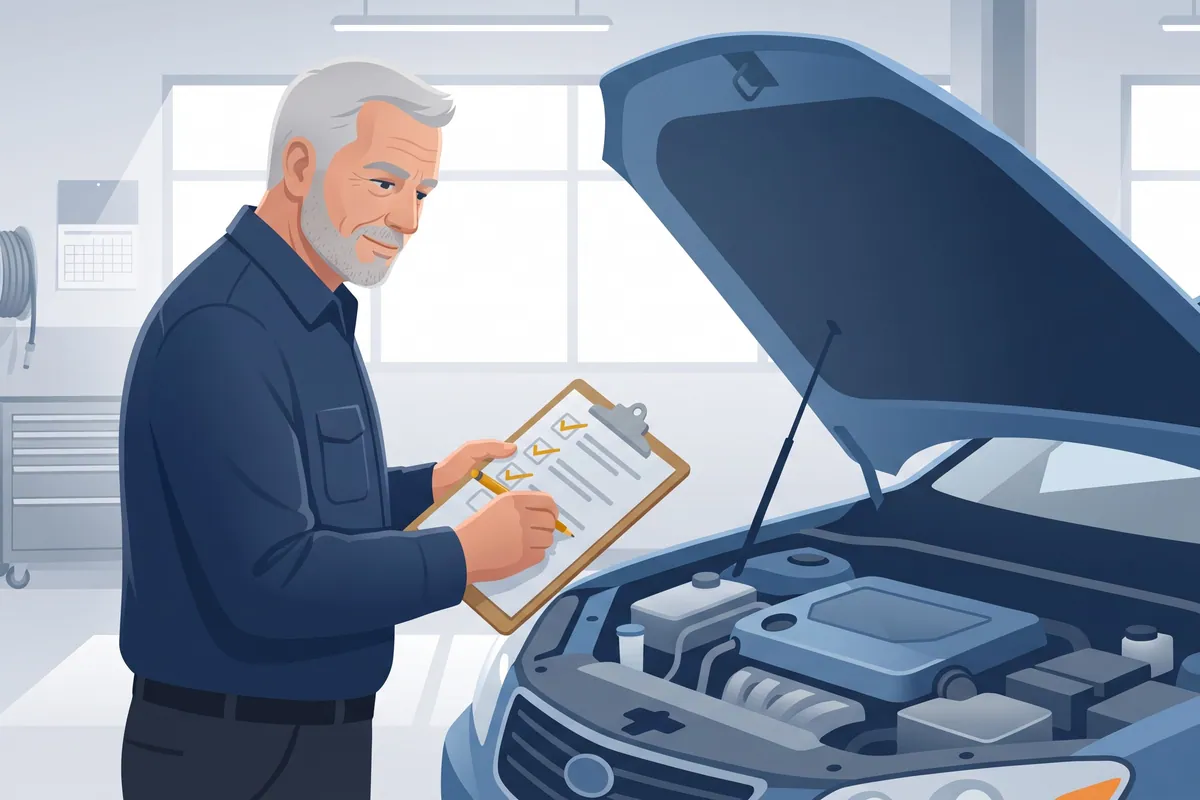

A vehicle inspection checklist is the fixed list of items a technician checks and records on every car, whatever the customer came in for. Without one, your multi-point inspection is whatever the tech remembers to look at, which is how a car leaves with a fresh oil change, a new air freshener, and a brake pad you could read the newspaper through.
(The customer always notices the air freshener. Always.)
This post gives you a complete shop-side vehicle inspection checklist, written to be filled out on every repair order. Full disclosure: I run WickedFile, which doesn’t inspect anything. It picks up after the inspection, matching the parts you order for the red items to the invoices and credits they create. I’ll get to that. The checklist comes first.
What a vehicle inspection checklist is for, and what it isn’t
In a repair shop, the checklist has two jobs. It makes sure every car gets the same look. And it turns that look into a written record the service advisor can sell from and the next tech can read.
Three things it is not:
- Not a state or DOT inspection. State safety and emissions programs use their own forms. Commercial trucks have their own federal rule: 49 CFR 396.17 says every commercial motor vehicle must pass an inspection at least once during the preceding 12 months, with documentation on the vehicle. If that’s what you came for, use the required form.
- Not a pre-purchase inspection. Checking a car someone is about to buy is a different job with different liability. That’s covered in pricing a used vehicle pre-purchase inspection.
- Not a software decision. Whether this lives on paper or a tablet is covered in digital vehicle inspection. The list is the same either way.
In the 2026 Ratchet+Wrench Industry Survey, 52% of shops reported using electronic inspection sheets. That still leaves a lot of clipboards, so the checklist below works on either.
A checklist beats a good tech’s memory
Your best tech doesn’t need a list to find a leaking strut. He needs a list to check the cabin filter on the fourth car of a Friday afternoon, when he’s behind and the customer is in the lobby.
Hope isn’t a process. “He usually checks that” is hope.
Here’s what a skipped inspection costs. It’s illustrative, built on survey bands, so use your own numbers.
In the Ratchet+Wrench survey, the most common band for found work per vehicle (sold and unsold) was $1,200 to $1,499, and the most common closing ratio band was 50% to 59%. Take the low ends: $1,200 found, half of it sold, so roughly $600 of sold work per inspected car.
Now say two cars a week go out without a real inspection. That’s about $1,200 a week in work nobody offered. Over 50 weeks, $60,000. Not every skipped car would have needed work, so treat that as a ceiling. But even a quarter of it is $15,000, and the fix is a sheet of paper.
Red items turn into parts orders, and that’s where the money slips
The checklist does its job. The tech marks the front pads red. The advisor quotes them. Then the paperwork part starts, and this is where shops lose the money they just made.
Here is the usual chain. Pads and rotors get ordered before the customer approves, because the car is on the lift and nobody wants to wait. The customer declines. The parts go on a shelf “to return later.” Later is a long time.
Illustrative example. A shop pre-orders parts on 20 declined jobs a month. Most get returned. Say three don’t: they sit on the shelf, or they go back on a return slip and the credit never shows up. At an average of $140, that’s $420 a month, about $5,000 a year, from parts that were never on a car.
And the part on the invoice has to be the same part on the repair order. If the tech’s recommendation says “front pads,” the RO says one part number, and the vendor invoice says another, nobody can prove what came back. A return slip shows the part left. It doesn’t prove the credit arrived. That gap is the whole subject of the return-and-forget loophole.
The manual fix: every Friday, list the parts ordered for declined work. Each one gets one of three outcomes: returned with a credit memo in hand, moved into stock on purpose, or chased.
The vehicle inspection checklist
Copy these tables into your vehicle inspection form, your SMS template, or a document you print. For each line, record the measurement or observation, then a status: G (good), Y (watch, recommend soon), R (needs attention now). Write the spec your shop uses into the form so every tech grades the same way.
Header (every sheet): RO number · date · technician · VIN · mileage in · customer’s stated concern.
1. Intake and warning lights
| Check | Record |
|---|---|
| Dash warning lights at key-on and running | Which lights are on |
| Scan for stored and pending codes | Codes, by module |
| Mileage vs. last service sticker | Miles since last service |
| Customer concern verified? | Yes / no / could not duplicate |
2. Under the hood
| Check | Record |
|---|---|
| Engine oil level and condition | Level, color, any sludge or milkiness |
| Coolant level and condition | Level, condition |
| Brake fluid level and condition | Level, condition or test result |
| Power steering fluid (if equipped) | Level |
| Transmission fluid (if checkable) | Level, condition |
| Washer fluid | Topped off? |
| Drive belt | Cracks, glazing, noise |
| Radiator and heater hoses | Soft, swollen, leaking |
| Engine air filter | Condition |
| Cabin air filter | Condition |
| Battery test | Test result vs. rating |
| Battery terminals and hold-down | Corrosion, loose |
| Visible leaks in the engine bay | Fluid and location |
3. Tires and wheels
| Check | Record |
|---|---|
| Tread depth, each tire, inner/center/outer | Three readings in 32nds |
| Tire pressure, each tire | Found pressure vs. placard |
| Wear pattern | Even, inner, outer, cupping |
| Sidewall damage, bulges, plugs | Location |
| DOT date code | Week and year, each tire |
| Spare tire | Present, pressure, condition |
| TPMS light or sensor fault | Yes / no |
| Lug nuts and wheel locks | All present, key in car |
Two federal rules help here. New radial tires for light vehicles must have tread wear indicators that show when the tread has worn to one sixteenth of an inch, under FMVSS 139. And the recommended cold pressure is on a placard that FMVSS 110 places on the driver’s side B-pillar. So record pressure against the placard, not against the number on the sidewall. Set your own yellow threshold for tread above the wear bars and print it on the form.
4. Brakes
| Check | Record |
|---|---|
| Front pads, inner and outer | Thickness in mm |
| Rear pads or shoes | Thickness in mm |
| Rotors and drums | Scoring, lip, pulsation reported |
| Calipers and slides | Sticking, leaks |
| Brake lines and hoses | Cracks, rust, leaks |
| Parking brake | Holds / does not hold |
5. Steering and suspension
| Check | Record |
|---|---|
| Inner and outer tie rods | Play |
| Ball joints | Play |
| Control arm bushings | Cracked, torn |
| Struts and shocks | Leaking, worn mounts |
| Sway bar links and bushings | Loose, worn |
| CV axles and boots | Torn boot, grease thrown |
| Wheel bearings | Noise, play |
6. Underneath the car
| Check | Record |
|---|---|
| Oil leaks | Location and how wet |
| Transmission and differential leaks | Location |
| Exhaust system and hangers | Leaks, rust, loose |
| Engine and transmission mounts | Cracked, collapsed |
| Fuel and brake lines | Rust, damage |
| Frame and floor pan | Rust, damage worth noting |
7. Lights and electrical
| Check | Record |
|---|---|
| Headlights, low and high | Working / out |
| Tail, brake and third brake light | Working / out |
| Turn signals and hazards | Working / out |
| Reverse and plate lights | Working / out |
| Horn | Working / not |
8. Interior and safety
| Check | Record |
|---|---|
| Wiper blades | Streaking, torn |
| Windshield | Chips, cracks in driver’s view |
| Seat belts | Fraying, retraction, buckle |
| HVAC, heat and AC | Working / weak / not |
| Mirrors | Cracked, loose |
Footer: total time spent · photos attached (yes/no) · items marked R · items marked Y · tech signature.
That’s 50-plus checks. It sounds like a lot until you watch a tech who knows the order do it. (I timed myself once, with a lot of confidence and a clipboard. The clipboard won.)
How to make the checklist stick
A checklist only works if every tech fills it out the same way. Four rules:
- Every car, every time. No “only on the big jobs.” Optional inspections happen on cars where someone already smells a sale.
- Write a measurement wherever there is one. “4 mm” beats a checkmark, because it lets the next visit show a trend.
- Put the RO number on every sheet. An inspection without an RO number is a piece of paper. With one, it’s a record that follows the car.
- Review one sheet per tech per week. Not to grade them. To make sure “yellow” means the same thing to everyone.
If you need a vehicle inspection checklist PDF, copy the tables into a document, add your logo and your yellow thresholds, and save it as a PDF. Edit it before you print it. A list your techs helped build gets filled out. A list from the internet gets pencil-whipped by Wednesday.
Every red item on the checklist ends up as an invoice somebody has to check
Here’s where WickedFile fits, and why it belongs in a post about a checklist.
Every red item that gets sold becomes a parts order. Every parts order becomes a vendor invoice. Some become returns, cores and credit memos. WickedFile reads those vendor invoices, credit memos and statements, pulls in your repair orders from your shop management system, and connects to QuickBooks Online and your bank and card feeds through Plaid. Then it flags what doesn’t line up:
- Parts bought for a repair order but never sold on it, like the declined brake job above.
- Returns with no credit memo behind them.
- Uncredited cores from the jobs you did sell.
- Invoices whose part numbers don’t trace back to a repair order. (Getting that number right at the counter is covered in part number search.)
How to spend the free trial on this. The trial is 500 scanned pages, no credit card. Pull last month’s invoices and credit memos from the vendor you buy brakes and suspension from. Run them through, then look at one list: parts bought for a repair order but not sold on it. Compare that to your declined-work report. The overlap is what your inspection sold and your back office lost.
The honest limits. WickedFile does not inspect cars, store inspection photos, or text results to customers. That’s your shop management system or DVI tool. It isn’t a payment processor, and it doesn’t replace QuickBooks or your bookkeeper. After the trial, the Grow plan is $299 a month, flat. If you pre-order parts on a handful of jobs a month and check every return by hand on Friday, you don’t need it yet.
Try it on last month’s brake and suspension invoices →
For the paperwork side of the RO itself, see what belongs on an auto repair order.
Print the list, put the RO number on it, and check the brake pads before the air freshener. The customer will still notice the air freshener first, but at least now the brakes will be on the sheet.