
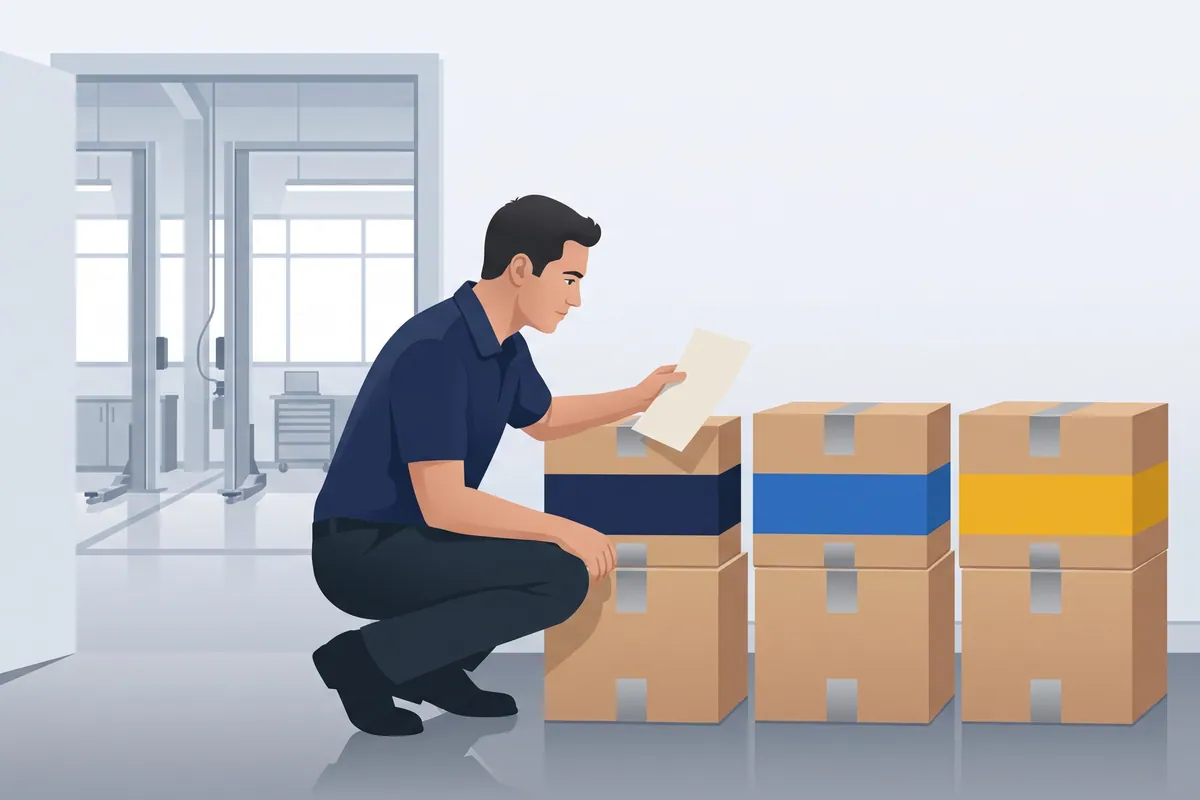

Vendor management at most repair shops is handled entirely by the delivery driver. He knows which bay door sticks, which tech wants the brake parts on the bench and not the floor, and how the parts manager takes his coffee. Nobody in the office knows his company’s return policy.
(I love those drivers. Some of them have been at the shop longer than the service advisors. They are just not supposed to be the whole program.)
Vendor management is how a business picks its suppliers, sets terms with them, watches how they perform, and controls the risk they bring. In a repair shop, that means your parts houses, dealers, tire distributors, sublets and paint suppliers. And it mostly happens on paper: invoices, return slips, cores, credit memos and the monthly statement.
Quick disclosure before we go further: I run WickedFile, which reads those invoices, credit memos and statements and tells you which vendor keeps leaving you short. You do not need it to do anything in this post. The manual version comes first.
What vendor management actually looks like in a repair shop
The generic definition is a lifecycle: select, onboard, set terms, monitor, review. Supplier management is the same thing with a different name tag. Procurement is the narrower act of buying.
That definition was written for companies with a contracts department. A repair shop’s version is faster and messier. Parts are ordered all day by advisors and techs under time pressure. Half the orders are by phone. Returns go back on the same truck that brought the replacement.
And you have a lot of vendors. In the 2026 Ratchet+Wrench Industry Survey of 430+ shops, 47% said they use five or more regular parts vendors each month. Five vendors means five sets of terms, five return policies, five ways a credit can go missing.
So for a shop, vendor management comes down to three questions:
- Are we buying from the right people on the right terms?
- Is each vendor billing what we agreed, and crediting what we sent back?
- Would we know if the answer to either one changed?
The vendor management process, built for a parts counter
Here is the process I would hand a new office manager. None of it needs software.
1. Keep one vendor list, and put the boring details on it
One row per vendor: account number, rep and phone, payment terms, pricing level, return window, restocking fee, core return process, how credits arrive (paper on the truck, email, portal) and statement date.
The return window and the credit method are the two columns people skip. They are also the two that cost money.
For service vendors, collect a W-9 when you set them up. A sole-proprietor mobile glass tech or tow operator generally needs a 1099-NEC once you pay them $2,000 or more in a year, for payments made after December 31, 2025, per the IRS 1099-NEC guidance. Payments to corporations and for merchandise are generally exempt, which is why your parts houses usually are not on that list. (Your CPA gets the final word. I just get the W-9s.)
2. Get terms in writing
Pricing level, payment terms, return window, restocking fees, core policy. If the rep agreed to it over a counter, it does not exist until it is in an email.
Payment terms matter more than most owners think. If a vendor offers something like 2/10 net 30 (2% off for paying in 10 days instead of 30), AccountingTools works out that giving up that 2% to keep your cash 20 extra days is like paying roughly 36% annual interest. On a $20,000 monthly statement, the discount is $400 a month. That is $4,800 a year for paying on time, which is the easiest money in the building.
3. Put the RO number on every order as the PO
This one habit makes everything downstream possible. An invoice with the RO number on it can be traced to a job. An invoice that says “Mike” cannot.
4. Close every return and core with a credit memo
A return slip proves a part left the building. It does not prove you got paid for it. Only the credit memo does that. Keep a running list of open returns and open cores, and cross them off only when the credit lands. Uncredited cores are where this list earns its keep.
5. Check the statement before you pay it
The statement is the vendor’s version of the month. Before you pay it, match it to your invoices and credits. That is its own discipline, and vendor statement reconciliation walks through it line by line.
6. Review every vendor quarterly
Pull the scorecard below. Then decide who gets more of your business and who gets a conversation.
Where vendor management quietly loses money
Here is where this usually falls apart. The process is fine on the buying side. It breaks on the way back.
A part goes back. The driver takes it. The credit is supposed to show up in a week or two. Nobody writes it down. Three weeks later, nobody remembers which part it was. The statement arrives without the credit, and it gets paid because the total looks about right. The credit is not lost, exactly. It is just enjoying a long vacation in someone else’s ledger.
Here is what that costs. Illustrative numbers, so use your own:
- A shop buys $40,000 a month in parts across six vendors.
- Returns and cores run 8% of purchases, so about $3,200 a month should come back as credits.
- If 10% of those credits never show up and nobody chases them, that is $320 a month, or $3,840 a year.
That sounds survivable until you put it next to net profit. Paar Melis’s 2025 benchmark report puts the average shop’s net profit at 9.6% of sales (2024 financials). At that margin, $3,840 of lost credits is the profit on about $40,000 of work. Your techs did that work. A missing credit memo ate it.
The reason it stays hidden is simple. Accounting software doesn’t verify reality. QuickBooks will happily record the bill the vendor sent. It has no idea you sent the starter back, or that the core went out on Tuesday’s truck. It shows that you owe. It cannot show that you should not.
Pricing drift is the other quiet leak: the invoice price creeping above the level you agreed to. That gets its own post on catching vendor overbilling, so I will not repeat it here.
A vendor scorecard that measures what actually costs you
Most vendor scorecards I see measure price and stop there. Price is the number the rep wants you to look at. Score these instead, per vendor, every quarter:
| What to score | How to measure it | Why it matters |
|---|---|---|
| Right part, first time | Wrong or failed parts ÷ total parts ordered | Every wrong part parks a tech |
| Delivery time | Typical order-to-bay time on a stock part | Bay time is your inventory |
| Pricing accuracy | Invoice lines above your agreed level | Drift adds up quietly |
| Credit turnaround | Days from return to credit memo | Slow credits get forgotten |
| Missing credits | Returns and cores with no credit after 30 days | This is lost money, not timing |
| Statement accuracy | Statements that match your records first try | A messy statement hides everything else |
Now the math that changes minds. Illustrative again.
Vendor A is 2% cheaper than Vendor B on $15,000 a month of parts. That saves $300 a month, or $3,600 a year. Easy call, right?
But Vendor A sends six wrong parts a month. Each one parks a tech for about half an hour while the right one comes. At the roughly $165 average labor rate that both Paar Melis and Ratchet+Wrench point to, that is about $495 a month in labor you could not bill. Add $180 a month in credits that never showed up, and Vendor A costs you $675 a month in hidden costs.
That is $8,100 a year in costs against $3,600 in savings. The cheap vendor is the expensive one. You only find that out if you score it.
Some vendor risk walks in carrying a ladder
Vendor management is not just parts houses. It also covers everyone you let inside the building.
Bob, my co-founder, learned this when he hired a painting company to repaint one of his shops, manager’s office included. The painters saw where the customer keys lived and where the cash deposits were kept. A few days later, a group broke in overnight, walked straight to the cash, then straight to the keys. Several customer cars were taken. One had a GPS tracker, which is how Bob got them back. Who passed along the floor plan was never proven.
The lesson was not “never hire painters.” It was that a service vendor’s access is part of vendor management. Before any contractor works inside, move keys and deposits somewhere they cannot see. Then put it back on the checklist next time.
Good parts vendor relationships survive being checked
I get why owners hesitate here. The rep is a friend. The counter guy saves you on Saturdays. Asking about missing credits feels like accusing them of something.
It is not an accusation. Good vendors make mistakes. Credits get keyed to the wrong account. A core gets logged as received at the warehouse and never makes it back to the branch. Those vendors want the error found as much as you do, because it eventually comes back on them too.
Two habits keep the relationship and the money:
- Send the list, not the complaint. A monthly email with “here are the five returns we have not seen credits for” gets fixed. “You guys keep missing credits” gets a shrug.
- Talk to the branch manager, not just the driver. The driver can carry a part. The branch manager can fix a process.
Trust, but verify. The vendors worth keeping will appreciate it.
A scorecard is only as good as the paper behind it
Here is the catch with everything above. The scorecard depends on data most shops are not collecting: every credit memo matched to its return, every core matched to its credit, every statement line matched to an invoice. That is where the hours go, and it is why most shops build a vendor list once and never score anyone.
That matching is what WickedFile does. It reads your vendor invoices, credit memos and statements, whether they arrive as PDFs, scans or photos. It pulls repair orders from your shop management system, bills and credits from QuickBooks Online, and bank and card transactions through Plaid. Then it flags what does not line up, by vendor: returns with no credit, uncredited cores, statement lines with no invoice behind them, invoices with no RO, and card charges with nothing attached.
Here is how I would spend the free trial (500 scanned pages, no credit card) on this exact problem. Take last month’s statements, invoices and credit memos from your two biggest parts vendors and run them. You will see which one has open credits, how old they are, and whether the statement agreed with the paper. That is the first two columns of your scorecard, filled in.
What it does not do: it will not negotiate terms, choose your suppliers, or call the branch manager for you. It is not a shop management system, it does not process payments, and it does not replace QuickBooks or your bookkeeper. After the trial, the Grow plan is $299 a month, flat.
Run your two biggest vendors through the free trial →
Keep the delivery driver. Buy him a coffee. Just let the office handle the credits. He already has everybody’s coffee order to remember.